

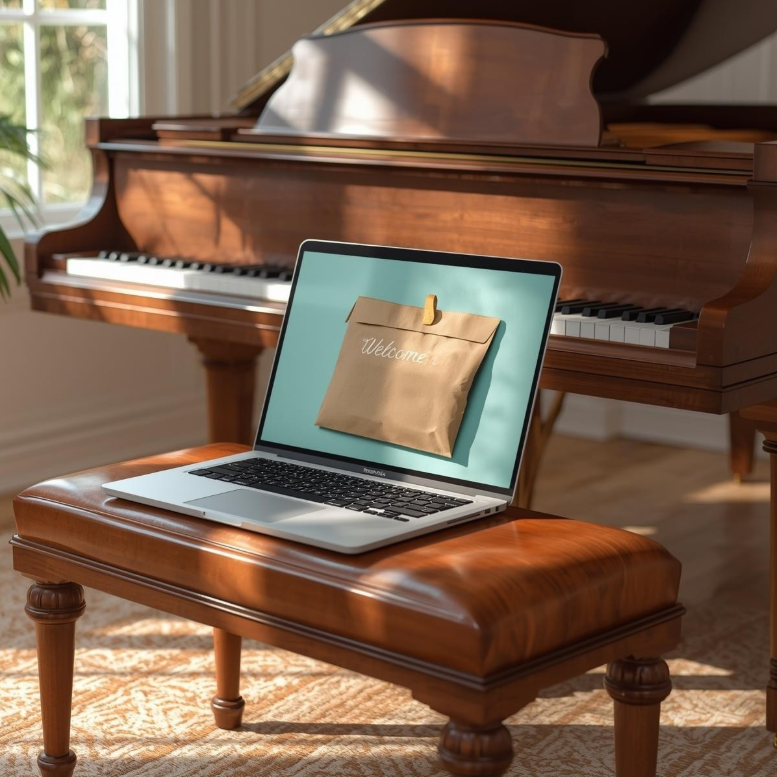
There’s a window between enrollment day and first lesson that most music studios leave completely empty.
No welcome. No context. No “here’s what to expect.” Just: “See you Tuesday.”
And in that window, the family you just enrolled is quietly asking themselves questions they’d never say out loud:
• Did we pick the right studio?
• What does the teacher actually expect from my child - and from me?
• What if my kid hates it after the first lesson?
They won’t ask you. They’ll Google, guess, and worry quietly.
I know this because I was that parent. My two kids started music lessons when they were six and eight. We were motivated, excited, and completely in the dark about what came next. The enrollment experience at their studio was warm. The gap that followed? Empty.
That experience is what led me to build Collaborative Endeavor - a resource designed to help music teachers fill that gap with intention. And it starts with a simple question:
|
What does a new family receive from you in the days between signing up and walking through your door? |
If the honest answer is “an invoice and a time,” this post is for you.
Why the Days Before Lesson One Matter More Than You Think
Here’s the stat that changed how I think about music teacher onboarding:
|
50% |
of music students quit within 1–2 years of starting lessons Source: Multiple longitudinal studies in music education, 2021–2025 |
Half. Within two years.
And here’s what the research consistently shows: most of those students didn’t leave because of the teacher’s skill. They didn’t leave because the instrument was too hard. They left because they never felt fully invested in the first place.
That investment - the emotional commitment a family makes to the process - is formed in the first two weeks. Before the third lesson. Often before the first.
What you send (or don’t send) in those early days tells a new family whether this is a place they belong. Whether you’re a teacher who sees them as a partnership, or a service provider who’ll send an invoice and hope they show up.
The good news: this window is entirely within your control. And filling it doesn’t require more of your time - it requires a system you set up once and use for every student, forever.
What Most Music Teachers Send (And Why It Falls Short)
Let’s be honest about the default.
Most new families receive some combination of:
• An invoice or payment confirmation
• A calendar invite or lesson time confirmation
• Maybe a brief “see you soon!” email
That’s it.
Nothing wrong with any of those things. They’re necessary. But they’re transactional. And a transactional first impression creates a transactional relationship - one that’s much easier for a family to exit when life gets busy, when the novelty wears off, or when the third lesson feels harder than the first two.
|
Invoice-first onboarding says: you’re a customer. Welcome-first onboarding says: you’re a partner. That difference is felt before a single note is played. |
The teachers who retain students year after year aren’t just better at teaching. They’re better at welcoming. And welcoming is a system, not a personality trait. It can be built, replicated, and delivered consistently regardless of how your Tuesday is going.
5 Things to Send New Music Students Before Their First Lesson
Here’s what a complete, intentional pre-lesson welcome looks like. You don’t have to build all of this at once - but each element serves a specific purpose in building family confidence and long-term commitment.
1. A Warm, Instrument-Specific Welcome Guide
Not a policy document. Not a terms sheet. A welcome.
This is the first thing a new family should receive, and it should feel like it was made for them - because it should reflect their specific instrument, your specific studio, and the experience you’re inviting them into.
A strong welcome guide includes:
• A genuine welcome that sets a warm, encouraging tone
• What to expect in early lessons - structure, pacing, what “progress” actually looks like in the first months
• Instrument-specific practice tips for beginners (parents need this more than students do)
• Styles and musical paths to explore - so families can see a horizon, not just a starting line
• What to bring, what to wear, and what to leave at home
The goal of this document isn’t to answer every policy question. It’s to make a new family feel like they made the right choice before they’ve heard their child play a single note.
2. A Meet the Teacher Introduction
New families are nervous about the unknown. The teacher is the biggest unknown.
A one-page teacher introduction - your story, your teaching philosophy, what you love about working with beginners, why you teach the instrument you teach - does something remarkable: it creates connection before the relationship has officially started.
When a parent reads about you before lesson one, they walk in already predisposed to trust you. When their child reads about you, they feel like they already know you. That changes the energy in the room from the first minute.
Keep it human. Keep it specific. Write it the way you’d introduce yourself to a new friend who asked why you became a music teacher. That’s the version that creates connection.
3. Practice Guides for Parents
This is the element most studios miss entirely - and it may be the most important one.
Parents desperately want to support their child’s practice at home. Most of them have no idea how. They know they’re supposed to “make sure their child practices,” but very few tell them what that actually means: how long, how structured, what to listen for, how to help without hovering.
When families don’t have a framework for home practice, one of two things happens: they nag (and practice becomes a battle) or they step back entirely (and progress stalls). Either path leads to the same destination: an early dropout.
Practice guides that work include:
• A simple daily practice structure (even 10–15 minutes can be framed clearly)
• A visual tracker children can see and interact with
• Goal-setting prompts for short-term wins
Give families this before lesson one and you’ve solved one of the most common reasons students quit - before they ever had the chance to quit.
4. A Parent Handbook That Answers The Questions They're Too Nervous to Ask
Clear policies aren’t just administrative. They’re trust signals.
When a new family knows exactly how cancellations work, what happens if their child is sick, how tuition is handled, and what you expect from them as a practice partner - they feel confident. And confident families don’t send the “we’ve decided to take a break” email at month three because something felt unclear and they never asked.
A complete parent handbook covers:
• Lesson policies (cancellations, makeups, weather, illness)
• Tuition and payment expectations
• Recital and performance information
• How to communicate with you between lessons
• What success looks like in the first six months
Not sure where to start? I’ve put together a fully editable Parent Handbook Template - eight pages, customizable for any studio, available as a Word doc you can make your own in under an hour.
|
Download the Parent Handbook Template 8 pages • Fully editable • Works in Google Docs, Pages, or Word |
5. A Welcome Email Sequence That Builds Momentum
A single welcome email is better than nothing. A sequence of 2-3 emails sent leading up to the first lesson is the difference between a family that walks into lesson one nervous and a family that walks in ready.
Here’s a simple three-email arc:
1. Same day they sign up. Immediate confirmation email:
Warm, human, brief. Confirm the details, express genuine excitement about working with their family, and let them know what to expect before lesson one. Attach the welcome guide here.
2. Pre-lesson prep email. Two days before lesson one:
Remind them of the time and location. Share one or two simple things. This email says: I’ve been thinking about your family’s first lesson.
3. Check-in email. Within a couple of days after lesson one:
Ask how it went. Share one specific thing to focus on in their first practice session. Invite any questions. This is the email that turns a transaction into a relationship.
These emails don’t need to be long. They need to be warm, specific, and timely. Written once, sent automatically, they become the voice of your studio even when you’re in the middle of teaching.
What Happens When You Get This Right
A new piano family receives your piano specific welcome packet, reads your teacher introduction, and looks through the practice guide before their child’s first lesson. They walk in informed and excited. The lesson goes well - not because you taught differently, but because they arrived differently.
Three weeks later, a likely text from that parent:
|
“I already told two friends about you. That welcome packet was unlike anything we’ve received from any class or activity. We feel so prepared.” |
That’s not an accident. That’s a system.
Research shows that 70% of customers refer businesses with a superior onboarding experience - not because they were asked, but because the experience was worth sharing. (Source: Customer Onboarding Studies, 2023)
And on the retention side, the math is just as compelling. Industry data suggests that 5x more revenue is required to acquire a new student than to retain an existing one. (Source: Harvard Business Review, 2014). If better onboarding helped you retain just three additional students for two additional years at $150 per month, that’s $10,800 in retained revenue - without spending a dollar on new student marketing.
The welcome experience isn’t soft. It’s a business strategy with a real number behind it.
How to Actually Deliver This to New Families
The simplest approach: send everything as a PDF attachment in your confirmation email, paired with the welcome email sequence.
If you use a CRM or studio management software, many platforms allow you to upload a PDF once and automate delivery to every new enrollment. Set it up once. Every new family receives the same warm, professional welcome from that point forward.
If you’re not using automation yet, a simple saved email draft works. The point is consistency. Every new family deserves the same first impression, regardless of whether you enrolled them on a Tuesday morning with full energy or a Friday afternoon running on fumes.
|
The teachers who retain students long-term aren’t the most energetic. They’re the most consistent. And consistency is easier when you have a system that works on your 60% days. |
Where to Start If You Don’t Have Any of This Yet
Start with the parent handbook. It’s the document that answers the most questions, prevents the most friction, and gives families the clearest sense that your studio is professionally run. Build from there.
Once the handbook is in place, add the email sequence. Then the practice guides. Then the welcome guide. You don’t have to build the entire system in a weekend - you just have to start, and add one piece at a time.
Or, if you’d rather start with a complete, ready-to-use system: the Prelude Collections at Collaborative Endeavor include all five elements - instrument-specific welcome guide, teacher introduction page, parent handbook template, practice guides, and a five-part welcome email sequence - fully editable in Canva, available for piano, guitar, voice, violin, cello, and drums.
|
Explore the Prelude Collections Instrument-specific welcome packages for piano, guitar, voice, violin, cello, and drums |
